.webp)

Industrial Mobility and the Importance of Reliable Castor Wheel Manufacturers
Industrial operations across India depend on uninterrupted internal movement of materials, components, tools, and finished goods. Whether in engineering plants, fabrication units, warehouses, automotive facilities, pharmaceutical production sites, logistics centres, or infrastructure-linked handling areas, movement efficiency directly affects productivity. If materials cannot be moved safely and smoothly within a facility, delays begin to impact dispatch schedules, machine utilisation, labour productivity, and overall process reliability. This is why mobility components are no longer viewed as secondary accessories. They form part of the operating system of a modern industrial facility and influence both output and workplace safety on a daily basis.
In this context, choosing experienced castor wheel manufacturers becomes an important industrial decision. A castor wheel is not just a rolling part attached to a trolley or machine base. It is a load-bearing movement solution that must support weight, maintain alignment, absorb operational stresses, and enable controlled directional movement under repetitive use. Poorly designed wheels may appear acceptable during initial installation but often fail under real-world usage, especially where heavy loads, uneven floors, or continuous handling cycles are involved. Such failures result in operator strain, equipment instability, floor damage, and higher replacement frequency. Over time, this affects cost control and operational continuity.
Rexello manufactures industrial castor wheels and mobility systems engineered for demanding usage conditions. The approach focuses on real application performance rather than generic load claims. By considering load patterns, movement frequency, floor interaction, and long-term durability, Rexello delivers heavy duty castor wheels that support stable and predictable handling across industries. Reliable mobility improves internal workflow, reduces maintenance interruptions, and helps facilities maintain safer and more efficient operations across extended production cycles.
Engineering and Manufacturing Standards Followed by Professional Castor Wheel Manufacturers
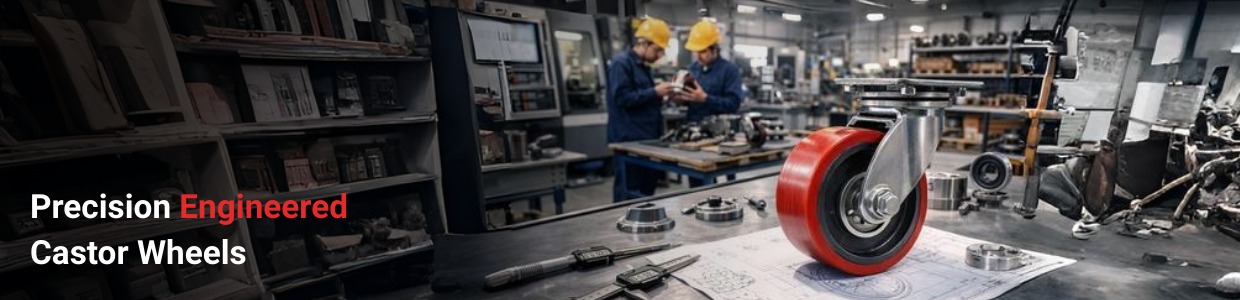
The long-term performance of a wheel assembly begins with engineering discipline. Professional castor wheel manufacturers do not design wheels only around diameter or nominal load rating; they evaluate how the wheel will behave under real operating conditions. In industrial environments, movement is repetitive and often unpredictable. Equipment may be pushed over floor joints, turned sharply in narrow aisles, stopped suddenly near workstations, or loaded unevenly during transit. These conditions generate combined forces that affect the wheel, the fork, the bearings, and the mounting system at the same time. If the engineering approach is weak, the wheel may still move initially but will quickly develop vibration, misalignment, or structural wear.
Rexello’s engineering approach to industrial castor wheels focuses on structural stability, load transfer balance, and smooth rolling under repetitive stress. The wheel hub, outer tread, bearings, and mounting assembly are treated as a single integrated mobility system rather than separate purchased parts. This matters because industrial movement performance depends on how accurately these components work together. Reinforced construction helps the wheel retain its geometry under pressure, while precision manufacturing improves concentricity and rotational consistency. In practical terms, this reduces rolling resistance, improves directional control, and supports operator safety during movement of heavy equipment and material handling platforms.
Manufacturing consistency is equally important. Even a well-designed castor can underperform if dimensional tolerances vary from one batch to another. Reputable castor wheel manufacturers maintain process control, material checks, and quality inspection so that replacement wheels deliver the same movement behaviour as previous installations. This consistency is critical for plants operating multiple trolleys, carts, and machine bases where standardisation simplifies maintenance and spare planning. Through engineering validation and disciplined production, Rexello provides industrial mobility solutions that are built not only to carry loads, but to sustain predictable movement quality over long operating cycles in demanding industrial environments.
Load Capacity Evaluation and Safety Performance in Industrial Applications
Load capacity is one of the first parameters buyers discuss with castor wheel manufacturers, but it is also one of the most misunderstood. Many facilities estimate wheel requirements by dividing the total equipment weight by the number of wheels and selecting a product that matches that figure. In practice, this method is incomplete because industrial movement introduces dynamic forces that significantly increase actual stress on the castor assembly. Starting motion, sudden braking, directional changes, floor unevenness, and shock from joints or debris all place additional load on the wheel. In many cases, one wheel temporarily carries more load than the others due to uneven distribution or shifting material, which increases the risk of deformation or failure if the selection was based only on static numbers.
Rexello recommends evaluating heavy duty castor wheels using maximum operational load conditions with a suitable safety margin, not just average working weight. This approach improves reliability in real applications where usage conditions vary throughout the day. In warehouses and production facilities, movement cycles are repetitive and often fast-paced, especially during dispatch or peak production windows. If a wheel is operating close to its limit, performance deteriorates faster, rolling effort increases, and structural components experience fatigue. Proper load evaluation allows the wheel to maintain shape, alignment, and smooth rotation across prolonged use, reducing both downtime and replacement frequency. It also supports stable handling when moving equipment through ramps, narrow passages, or shared production lanes.
Safety performance is directly linked to correct load selection. When castors are overloaded or improperly rated, operators may struggle to control movement, increasing the chance of accidents, tipping, or collision with machinery and storage structures. Correctly selected industrial castor wheels improve directional stability, reduce vibration, and maintain predictable movement behaviour even under heavy loads. They also help protect mounting plates, equipment frames, and floor surfaces from concentrated stress. By working with experienced castor wheel manufacturers and evaluating real movement conditions, industrial buyers can improve handling safety, equipment life, and overall operational continuity at the same time.
Wheel Material Selection and Its Impact on Durability, Floor Protection, and Handling Efficiency
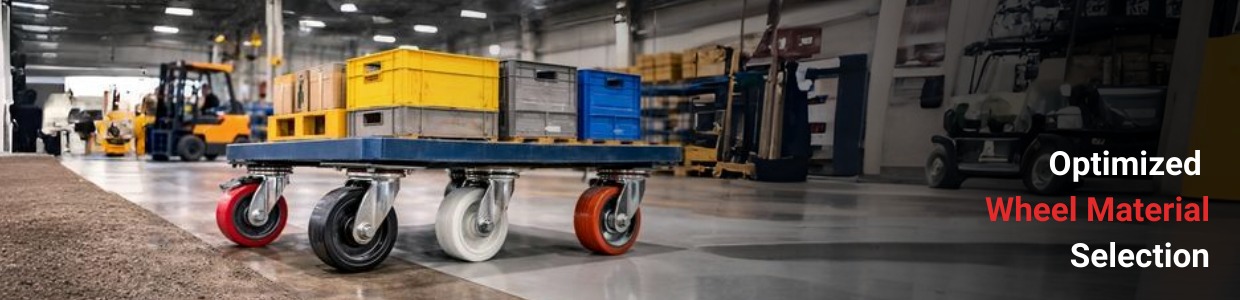
Wheel material selection is one of the most important performance factors in any mobility system supplied by castor wheel manufacturers. The same load capacity can produce very different movement results depending on the wheel material used, because the tread and wheel body directly interact with the floor surface and absorb operational stresses during rolling. Industrial facilities do not operate under identical conditions. Some have rough concrete floors with dust, metal particles, and expansion joints. Others use smoother coated surfaces where floor finish must be protected. In some environments, exposure to oils, chemicals, moisture, or temperature variation further influences wheel behaviour. If the material is not matched to these conditions, the castor may wear rapidly, create noise, damage the floor, or increase manual effort during handling.
Rexello evaluates application conditions before recommending wheel materials for industrial castor wheels and heavy duty castor wheels. Harder materials generally offer higher abrasion resistance and strong load-bearing support on rough industrial surfaces, making them suitable for engineering workshops, fabrication units, and heavy-duty material movement. Softer or specially selected compounds can provide improved floor grip, smoother rolling, and reduced floor marking in facilities where movement control and surface protection are important. The objective is not simply to choose the “strongest” material but to select a wheel compound that supports the required load while maintaining stable and efficient movement in the actual operating environment. This helps improve wheel life and preserves performance consistency over repeated handling cycles. Material selection also affects operator productivity and maintenance cost. A wheel with the wrong tread characteristics may technically carry the load but create excessive rolling resistance, causing higher push-pull effort and operator fatigue across long shifts. Over time, this slows internal movement and reduces handling efficiency. Correctly selected wheel materials roll more smoothly, reduce vibration, and support controlled movement, especially for platform trolleys and repetitive transport tasks. By aligning wheel compound properties with floor type, application intensity, and environmental exposure, professional castor wheel manufacturers help facilities achieve better durability, lower replacement frequency, improved floor protection, and more efficient day-to-day material handling performance.
Bearings, Mounting Systems, and the Importance of Movement Stability Under Continuous Use
Many buyers focus heavily on wheel size and load rating, but the movement quality of a castor assembly depends just as much on bearings and mounting design. Experienced castor wheel manufacturers understand that a strong wheel alone cannot deliver reliable handling if rotational support and structural attachment are weak. Bearings determine how smoothly the wheel rotates under load, while the mounting system determines how effectively forces are transferred between the equipment and the floor. In industrial environments where heavy loads are moved repeatedly, even a small increase in friction or instability can significantly affect operator effort, movement control, and component life. Poor bearing quality often causes resistance, uneven rolling, and faster wear, especially under continuous duty cycles.
Rexello integrates bearing systems suitable for industrial movement conditions so that heavy duty castor wheels maintain smooth rotation under sustained load. Efficient bearing performance reduces rolling resistance, which is especially important when operators move equipment manually across long distances or through production lanes with frequent turning. Lower friction not only improves manoeuvrability but also reduces strain on the wheel structure and mounting assembly. Over time, this contributes to longer service life and more predictable handling. In practical operation, good bearing performance can be felt immediately through reduced effort, smoother travel, and better control during starts, turns, and stops. This becomes increasingly important in facilities where handling speed and safety must be maintained simultaneously.
Mounting systems are equally critical because they anchor the castor assembly to the equipment and absorb movement stresses created during operation. Reinforced mounting plates, secure fastener compatibility, and stable fork construction help maintain alignment and reduce vibration. If mounting integrity is weak, castors may loosen over time, resulting in wobble, noise, and unsafe handling behaviour. Reliable industrial castor wheels are therefore engineered as complete assemblies in which wheel, bearings, fork, and mounting structure are designed to work together. By treating mobility as a system and not just a wheel component, professional castor wheel manufacturers help industrial facilities achieve stable movement, improved operator control, and reduced maintenance interruptions across continuous-use applications.
Industrial Applications and Operational Environments Where Castor Wheel Performance Becomes Critical
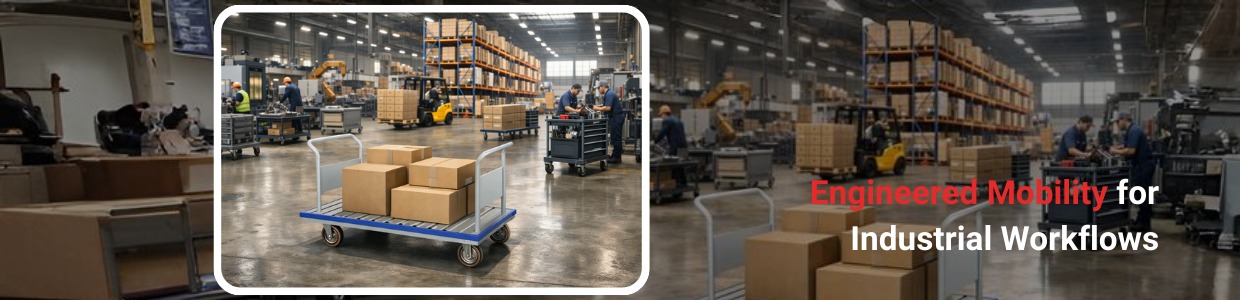
The role of industrial castor wheels extends across a wide range of sectors, and performance expectations vary significantly from one application to another. In manufacturing plants, castors are used on assembly fixtures, material bins, platform trolleys, and machine support systems that move components between production stages. In warehouses and logistics hubs, they support internal transport of packed goods, inventory bins, and dispatch-ready material across long floor spans. In maintenance departments, castor-mounted carts help technicians move tools, spare parts, and repair assemblies quickly across large facilities. In each of these settings, wheel performance affects movement speed, operator comfort, and safety. A castor that performs adequately in a light-duty cart may fail when used in repetitive industrial movement, even if the dimensions appear similar.
Rexello designs mobility systems after understanding where and how the wheels will actually be used. This application-led approach is essential because castor wheel manufacturers must consider more than load capacity. The floor condition, frequency of movement, turning radius, environmental exposure, and handling pattern all influence wheel selection. For example, long-distance movement in warehouse aisles requires smooth rolling and low resistance, while handling heavy fabricated parts in engineering units requires stronger structural support and wear resistance. In some facilities, controlled movement and floor protection are more important than speed. Matching the castor configuration to the operational environment ensures that the wheel performs reliably under real conditions rather than only on paper specifications.
When castors are correctly selected for the application, facilities experience measurable operational benefits. Movement becomes smoother and more predictable, operators expend less effort, and equipment remains stable during transport. This improves workflow continuity, particularly in high-frequency handling processes where small delays multiply across shifts. It also reduces maintenance burden because wheel wear, mounting stress, and handling-related damage are minimised. For these reasons, experienced castor wheel manufacturers play a direct role in industrial productivity. By supplying application-appropriate heavy duty castor wheels and movement systems, Rexello supports facilities that depend on stable, efficient, and repeatable internal mobility as part of their day-to-day operations.
Selecting the Right Industrial Castor Wheel Supplier for Long-Term Reliability and Standardization
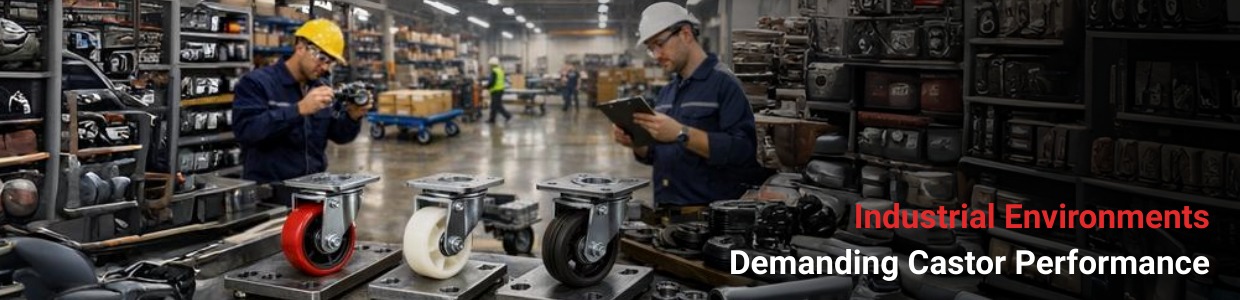
Choosing from multiple castor wheel manufacturers is not only a purchasing decision but a long-term operational decision for industrial facilities. The right supplier affects equipment reliability, spare standardization, maintenance planning, and day-to-day handling consistency. Many buyers initially compare products by price and basic dimensions, but industrial usage quickly reveals the importance of manufacturing quality, dimensional consistency, and technical understanding. A castor wheel that appears similar in specification may perform very differently depending on material quality, bearing integration, fork strength, and production tolerances. When facilities operate dozens or hundreds of castor-based units, these differences become significant in terms of downtime, replacement cycles, and labour efficiency.
A reliable supplier should understand real application conditions and provide guidance based on usage rather than generic catalogue matching. Rexello supports this requirement by focusing on engineered industrial castor wheels designed for practical movement demands. This includes attention to structural performance, rolling behaviour, and repeat-order consistency. Standardization is especially important for plants that maintain multiple trolleys or machine bases across departments. If replacement castors vary in height, fitment accuracy, or rolling characteristics, equipment performance becomes inconsistent and maintenance teams spend more time troubleshooting avoidable issues. Reputable castor wheel manufacturers therefore maintain process control and inspection standards so that repeat supplies perform consistently across installations.
Long-term reliability also depends on supplier support and continuity. Industrial buyers often need assistance selecting wheel types for new applications, upgrading load capacity, or matching existing configurations during maintenance replacements. A supplier with technical understanding can reduce selection errors and improve service life by recommending suitable wheel material, bearing type, and mounting arrangement. Over time, this reduces hidden operational costs that are often larger than the difference in purchase price. By working with experienced castor wheel manufacturers like Rexello, facilities gain not only a product source but a dependable industrial mobility partner capable of supporting performance consistency, maintenance efficiency, and reliable internal movement across evolving operational requirements.
Engineering Assistance and Product Selection Guidance
Industrial facilities operate under specific handling conditions that must be evaluated before selecting mobility components. Floor type, load pattern and operating environment all influence performance. Choosing wheels only based on size often leads to inefficiency.
Rexello supports engineering teams and purchase departments in identifying suitable industrial castor wheels based on working conditions. Appropriate materials, bearing types and mounting arrangements ensure reliable performance and long service life.Correct selection improves workflow efficiency and reduces maintenance interruptions. Stable movement allows consistent operations across departments.
For technical guidance and product information, Rexello’s team can be contacted at:
📧 info@rexello.com | 📞 +91-79001 47477 | 🌐www.rexello.com
Frequently Asked Questions:-
A1: They manufacture load-bearing wheels used for moving machinery, trolleys and equipment in factories and warehouses. These wheels are designed for durability, stability and smooth handling.
A2: Selection depends on load capacity, floor surface and operating conditions. Considering maximum working load ensures safe movement and longer service life.
A3: Heavy duty castor wheels carry higher loads while maintaining control and balance. They improve safety and reduce operator effort during equipment movement.
A4: They need minimal maintenance if properly selected. Occasional inspection of wear and mounting tightness helps maintain reliable performance.