.webp)

Mobility Is the Hidden Load-Bearer on Construction Sites
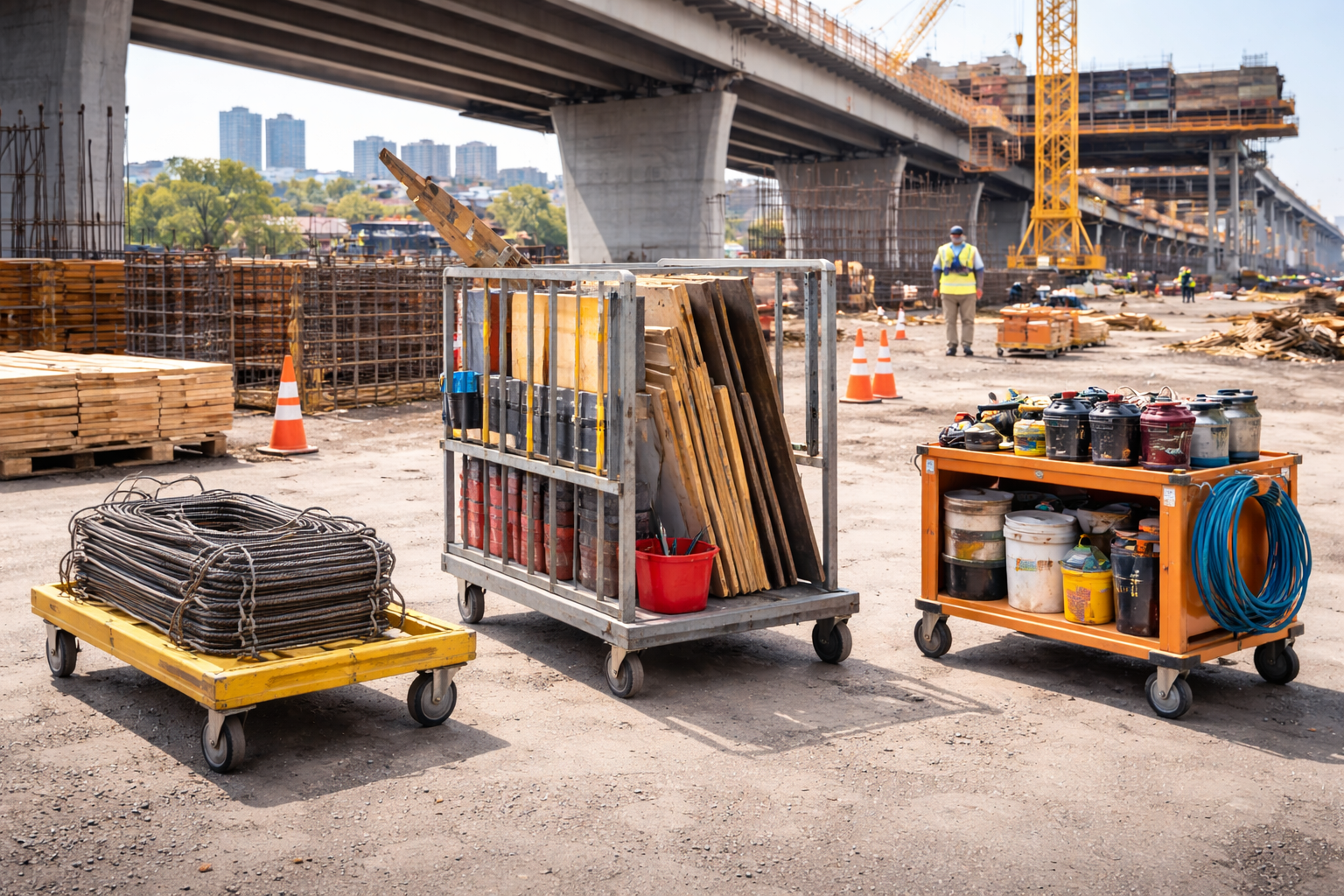
Heavy Load Castors are used because Construction sites and bridge projects are environments where stress is constant—not just structural stress on materials, but operational stress on people, equipment, and timelines. Every day, heavy loads such as steel sections, shuttering panels, tools, welding machines, generators, formwork accessories, concrete accessories, and maintenance equipment must be moved repeatedly across uneven, temporary, and often hazardous surfaces.
Unlike controlled industrial floors, construction sites are dynamic. Surfaces change daily. Ramps are temporary. Floors are uneven. Weather introduces dust, water, and mud. Loads are rarely uniform. Movement paths are constrained. In such environments, transport stress becomes a serious operational problem.
Transport stress manifests as excessive manual effort, equipment instability, frequent breakdowns, material damage, worker fatigue, safety incidents, and schedule delays. At the center of this stress is often a poorly designed or incorrectly selected mobility system—especially castor wheels.
This is why heavy-load castors are not optional accessories in construction and bridge works. They are structural mobility components that directly influence safety, productivity, and project efficiency.
Understanding Transport Stress in Construction and Bridge Projects
Transport stress in construction is cumulative. It builds up through repeated inefficiencies rather than single catastrophic failures. When heavy equipment is difficult to move, workers exert more force. When wheels snag on debris or sink into uneven ground, carts tilt and loads shift. When castors are under-rated, bearings wear prematurely, causing vibration, noise, and sudden seizure.
Bridge works amplify these challenges. Work often takes place on elevated decks, narrow platforms, temporary scaffolding, or formwork systems. Loads must be moved safely near edges, over joints, and across expansion gaps. Any instability increases risk—not only to materials but to lives.
In such conditions, the difference between standard industrial wheels and engineered heavy-load castors becomes critical. Heavy-load castors are designed to absorb shock, distribute weight evenly, maintain directional stability, and roll predictably under extreme conditions.
Why Standard Wheels Fail on Construction Sites
Standard catalogue wheels are typically designed for warehouses or factories with smooth floors and predictable loads. When exposed to construction conditions, they fail quickly.
Uneven surfaces cause localized overloading. Debris introduces point impacts. Temporary ramps increase rolling resistance. Weather introduces moisture and dust into bearings. Under these stresses, light-duty or even medium-duty wheels develop flat spots, cracked treads, bent brackets, or seized bearings.
Once a wheel begins to fail, transport stress increases exponentially. Workers compensate with force. Loads become unstable. Equipment suffers secondary damage. Safety risks rise. What began as a small component failure becomes a site-wide productivity issue.
What Makes Heavy-Load Castors Different
Heavy-load castors are not simply “bigger wheels.” They are engineered systems designed to perform under dynamic load, shock, vibration, and unpredictable surfaces.
These castors use reinforced forks and brackets that resist torsion when loads shift during movement. Bearings are designed for high radial and axial loads, ensuring smooth rotation even when weight distribution is uneven. Wheel materials are selected to balance load capacity, shock absorption, and surface adaptability.
Most importantly, heavy-load castors are rated for dynamic performance, not just static load. This distinction is critical in construction, where movement, not storage, defines stress.
Reducing Manual Effort and Worker Fatigue
One of the most immediate benefits of heavy-load castors is reduced push and pull force. On construction sites, workers often move equipment manually due to space constraints or the impracticality of mechanical lifting for short distances.
Poor-quality wheels increase rolling resistance, forcing workers to apply excessive force. Over time, this leads to fatigue, strain injuries, and reduced productivity. Heavy-load castors, with precision bearings and optimized tread profiles, significantly reduce rolling resistance—even under high load.
This not only improves efficiency but also enhances worker safety and morale. Reduced effort means better control, fewer sudden movements, and lower risk of slips or collisions.
Improving Stability on Uneven and Temporary Surfaces
Construction and bridge works rarely offer uniform surfaces. Steel plates, plywood sheets, concrete pours, gravel, and temporary decking all create rolling challenges.
Heavy-load castors are designed with wider tread profiles and shock-absorbing materials that bridge small gaps and absorb surface irregularities. Reinforced swivel assemblies maintain alignment, preventing wobble or oscillation during movement.
This stability is especially important when moving loads near edges, on elevated platforms, or across temporary ramps—common scenarios in bridge construction.
Controlling Shock and Protecting Equipment
Construction equipment is expensive and sensitive. Welding machines, surveying instruments, hydraulic tools, and electrical panels can suffer damage from repeated vibration and impact during transport.
Heavy-load castors incorporate materials and geometries that absorb shock rather than transmitting it directly to the equipment. This protection extends the life of both the equipment and the mobility system itself.
In bridge works, where precision alignment and calibration are critical, minimizing vibration during transport can directly impact quality and rework rates.
Enhancing Safety in High-Risk Environments
Safety is paramount on construction sites. Heavy loads moving unpredictably pose serious hazards. Poor castor performance can cause sudden stops, sideways slips, or tipping—especially on sloped or uneven surfaces.
Heavy-load castors offer predictable rolling behavior, controlled braking options, and stable directional control. This predictability allows workers to anticipate movement, maintain balance, and respond safely to obstacles.
In bridge works, where movement often occurs near drop-offs or over water, this level of control is essential.
Durability Under Harsh Site Conditions
Construction environments expose castors to dust, debris, moisture, cement slurry, oils, and temperature variations. Heavy-load castors are built with sealed bearings, robust materials, and protective finishes to withstand these conditions.
Durability reduces maintenance interruptions. Fewer wheel replacements mean less downtime, fewer work stoppages, and more predictable project scheduling.
Bridge Works: Where Mobility Errors Have Higher Consequences
Bridge construction amplifies every mobility challenge. Loads are heavier, spaces are tighter, and consequences of failure are greater. Moving formwork components, steel sections, or maintenance equipment across bridge decks requires absolute reliability.
Heavy-load castors provide the necessary confidence. Their ability to handle uneven joints, expansion gaps, and temporary surfaces while maintaining stability reduces risk and improves workflow efficiency.
Lifecycle Cost: Why Heavy-Load Castors Are Economical
While heavy-load castors may have a higher upfront cost, their lifecycle economics are superior. Reduced failure rates, lower maintenance frequency, improved safety, and higher productivity deliver substantial cost savings over the duration of a construction project.
Replacing cheap wheels multiple times during a project is far more expensive than investing once in engineered heavy-load castors.
How Rexello Engineers Heavy-Load Castors for Construction
Rexello designs heavy-load castors specifically for construction and infrastructure environments. These solutions combine reinforced steel brackets, precision bearings, optimized wheel materials, and load ratings validated for dynamic performance.
Rexello supports construction OEMs and contractors with application analysis, customization, and consistent batch quality—ensuring predictable performance across sites and projects.
Conclusion: Heavy-Load Castors Are Structural Tools, Not Accessories
In construction and bridge works, mobility is not a convenience—it is a structural requirement. Heavy-load castors reduce transport stress by improving stability, lowering manual effort, protecting equipment, and enhancing safety.
They enable smoother workflows, reduce downtime, and contribute directly to project efficiency and worker well-being. In environments where conditions are unpredictable and loads are extreme, engineered heavy-load castors are essential infrastructure components.
CTA – Rexello
Handling heavy equipment on construction sites or bridge projects?
Rexello manufactures heavy-load castors engineered for dynamic loads, uneven surfaces, and harsh site conditions.
📧 info@rexello.com | 📞 +91-79001 47477 | 🌐 www.rexello.com