.webp)

Why Airport Mobility Deserves Special Engineering Attention
Airports are among the most complex operational environments in the world. Unlike factories or warehouses, airport operations never pause. From the first flight before dawn to the last arrival past midnight, high capacity airport mobility systems operate continuously—under heavy load, across long distances, and within public-facing environments where reliability, safety, and efficiency are non-negotiable.
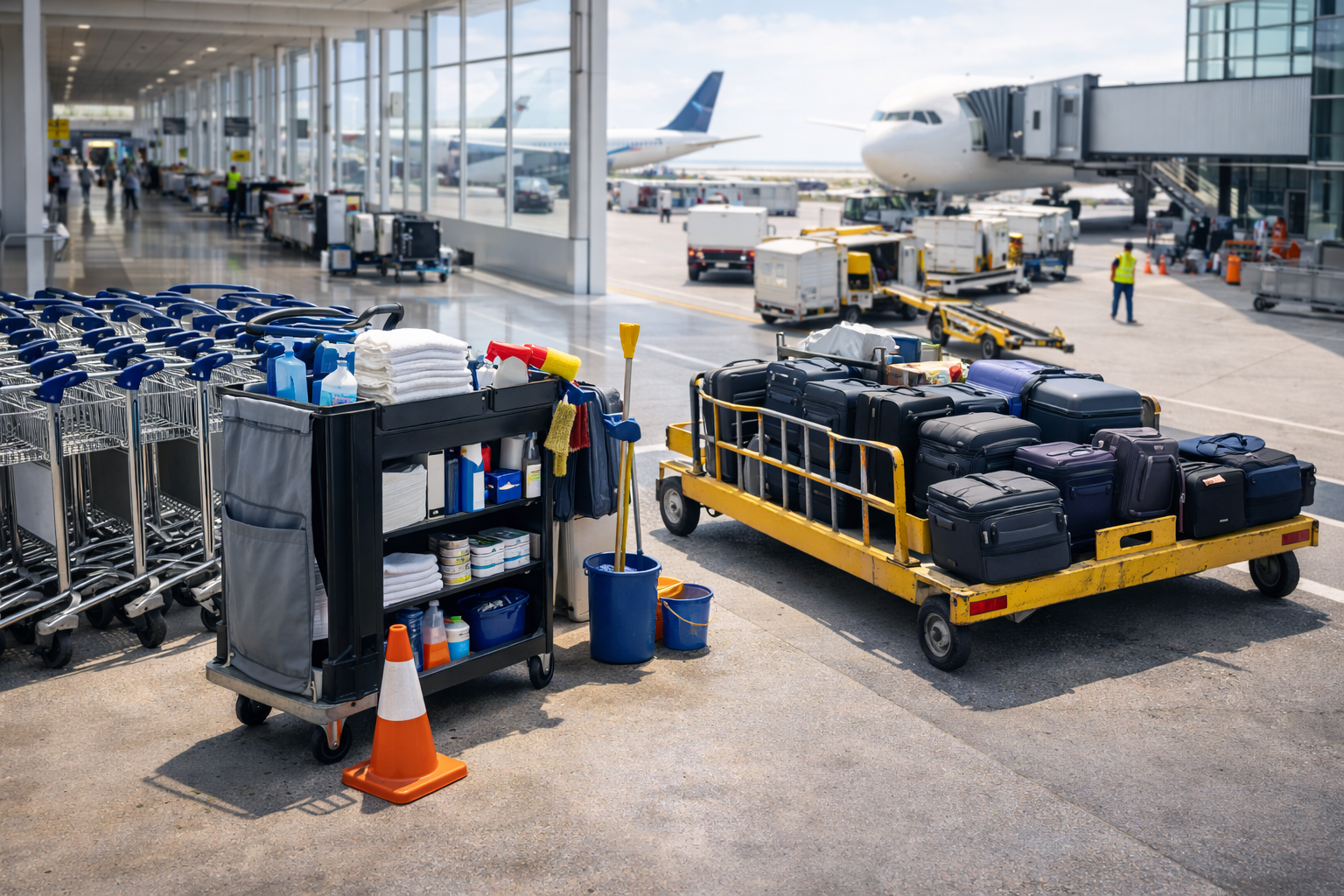
Every day, airports depend on mobility equipment such as luggage trolleys, baggage carts, cargo dollies, catering carts, housekeeping units, maintenance carts, security screening equipment, emergency response trolleys, and aircraft service utilities. The common but often overlooked component enabling all this movement is the castor wheel.
While castors may appear to be minor components, in airports they play a mission-critical role. A single wheel failure can delay baggage handling, disrupt terminal flow, increase operator fatigue, cause noise complaints, or even pose safety risks in emergency situations. This is why precision bearing castors are essential for maintaining high-capacity airport mobility.
This article explains, in depth, how airports can sustain smooth, silent, and reliable mobility by using engineered precision bearing castors, and why generic or catalogue-grade wheels consistently fail in aviation environments.
The Unique Mobility Challenges Inside Airports
Airport mobility differs fundamentally from most industrial or commercial environments. The challenge is not just weight, but combination stress.
Carts move across long corridors, ramps, jet bridges, cargo terminals, tiled passenger zones, epoxy-coated service tunnels, outdoor aprons, and loading docks—often in a single operational cycle. Each surface transition introduces frictional changes that test bearing precision and wheel alignment.
Additionally, airport loads are rarely static. Luggage trolleys may be lightly loaded at check-in but heavily overloaded near baggage reclaim. Catering carts experience uneven weight distribution. Maintenance carts carry dense tools. Emergency carts must accelerate quickly and stop abruptly.
Generic castors are typically rated for static load, measured in ideal laboratory conditions. Airports demand dynamic load performance, which includes shock, vibration, turning torque, and continuous rolling resistance. Precision bearing castors are specifically engineered for this reality.
Continuous Duty: The Hidden Enemy of Low-Grade Wheels
One of the most underestimated factors in airport mobility is continuous duty.
Most castor wheels fail not because of sudden overload, but because of bearing fatigue caused by prolonged rolling under moderate load. Airport equipment often operates 16–20 hours a day, every day, without cooling or rest cycles.
Low-quality bearings flatten, seize, or develop play. This leads to wobble, increased push force, noise generation, and eventually structural failure of the wheel or fork. Precision bearing castors, by contrast, are designed with deep raceways, hardened steel balls, and sealed lubrication systems that maintain smooth rotation even under prolonged stress.
The result is predictable performance, lower friction, and significantly extended service life.
Noise Control: Protecting Passenger Experience and Airport Reputation
Noise is not merely an inconvenience in airports—it is a brand and comfort issue.
The sound of rattling luggage carts or squeaking service trolleys echoes across terminals, especially in high-ceilinged spaces. This noise is amplified during night operations and early-morning hours when ambient sound levels are low.
Noise originates from bearing play, uneven wheel tread, poor swivel alignment, and inconsistent rotation. Precision bearing castors reduce noise at the source by maintaining tight tolerances, concentric rotation, and vibration dampening through engineered tread materials.
For passenger-facing zones such as terminals, lounges, and boarding gates, PU precision bearing castors are especially effective, delivering near-silent rolling without sacrificing load capacity.
Floor Transitions and Directional Stability
Airport carts rarely travel in straight lines. They navigate queues, security lanes, boarding bridges, service corridors, elevators, and ramps. Each turn introduces lateral force on the wheel assembly.
Standard castors often develop directional flutter under these conditions, where the wheel oscillates instead of tracking smoothly. This increases push effort and reduces control—dangerous in crowded passenger areas.
Precision bearing castors are designed with optimized swivel geometry and balanced bearing distribution, ensuring smooth directional changes and stable tracking even at higher speeds. This stability reduces operator fatigue and improves overall safety.
Corrosion, Moisture, and Chemical Exposure in Airport Environments
Airports are cleaned constantly. Floors are washed with disinfectants, carts are exposed to moisture, and outdoor equipment faces rain, humidity, and coastal air in many regions.
Additionally, aviation environments expose equipment to jet fuel residue, hydraulic oils, de-icing chemicals, and temperature fluctuations. These conditions quickly degrade untreated steel components and unsealed bearings.
Precision bearing castors designed for airports use corrosion-resistant finishes, stainless steel components, sealed bearing units, and non-absorbent treads. This prevents rust, contamination, and premature failure, while maintaining hygienic operation—particularly important for catering and medical carts.
Where Precision Bearing Castors Make the Biggest Impact
Precision bearing castors are especially valuable in passenger luggage trolleys, where low push force and silent rolling improve passenger comfort. In cargo terminals, they enable smooth handling of heavy loads without bearing collapse. In catering operations, they ensure hygienic, spill-free movement. In housekeeping and maintenance carts, they resist chemical exposure and reduce downtime. In emergency and medical carts, they provide stability and rapid maneuverability when seconds matter.
In each case, the benefit is not just durability, but operational continuity.
Lifecycle Cost: Why Cheap Wheels Are Always Expensive
Procurement decisions often focus on unit price. In airports, this approach is costly.
Low-grade castors require frequent replacement, increase labor hours, cause service interruptions, and damage floors. The indirect costs—downtime, safety incidents, passenger dissatisfaction—far exceed the initial savings.
Precision bearing castors reduce total cost of ownership by extending replacement cycles, minimizing maintenance, lowering push force (reducing operator injury risk), and preventing collateral damage. Over a typical airport equipment lifecycle, the ROI is substantial.
Rexello’s Approach to Airport Mobility Engineering
Rexello designs castor wheels specifically for continuous-duty, high-capacity, public infrastructure environments. For airport applications, Rexello focuses on precision bearing assemblies, PU and nylon tread optimization, corrosion-resistant structures, and dynamic load validation.
Rexello supports airport OEMs and facility operators with application analysis, CAD integration, material selection, and batch consistency—ensuring every trolley or cart performs predictably across its lifecycle.
Conclusion: Precision Castors Are Infrastructure, Not Accessories
In airports, mobility is infrastructure. Castor wheels are not accessories—they are load-bearing, safety-critical components that determine how efficiently an airport functions.
Precision bearing castors enable silent movement, reduce fatigue, resist corrosion, maintain control under dynamic load, and dramatically lower lifecycle costs. For airports seeking reliability, safety, and passenger comfort, precision engineering is not optional—it is essential.
CTA – Rexello
Looking to upgrade airport luggage trolleys, catering carts, cargo equipment or service mobility?
Rexello manufactures precision bearing castors engineered for 24×7 airport duty—silent, corrosion-resistant and built for dynamic load.
📧info@rexello.com | 📞 +91-79001 47477 | 🌐 www.rexello.com