.webp)

Marine Mobility Is an Engineering Challenge, Not a Hardware Choice
PU & Stainless Steel Castors are best because Marine and coastal environments are among the harshest operating conditions for any mechanical component. Unlike indoor industrial facilities, ports, shipyards, harbours, offshore platforms and coastal processing plants operate in a constant state of corrosion exposure.
Salt-laden air, seawater splash, humidity, temperature fluctuations, UV exposure, heavy loads and continuous duty cycles combine to create a perfect failure environment for standard mobility components. In these conditions, ordinary castor wheels fail rapidly, often within months.
Marine operators frequently face seized bearings, rusted brackets, cracked wheels, excessive noise, floor damage and unsafe mobility—leading to downtime, safety risks and repeated replacement costs.
This is why stainless steel assemblies combined with polyurethane (PU) wheels have become the preferred standard for marine mobility applications. They are not premium by choice, but essential by environment.
This article explains why stainless steel & PU castors consistently outperform other wheel types in salty, wet and humid marine environments, and how they protect uptime, safety and lifecycle cost.
Understanding the Marine Environment: Why Standard Castors Fail
Marine environments impose a unique combination of stresses that few industrial components are designed to handle simultaneously. Salt particles in the air accelerate oxidation. Moisture penetrates bearing raceways. Humidity prevents proper drying after wash-downs. Temperature changes cause material expansion and contraction. UV exposure degrades rubber compounds. Heavy loads add mechanical stress to already weakened materials.
Standard mild steel brackets corrode quickly. Zinc plating erodes under salt exposure. Carbon steel bearings seize due to rust. Rubber wheels absorb moisture and swell. Nylon becomes brittle under UV exposure. Grease washes out, leaving bearings dry and exposed.
What makes marine conditions especially dangerous is that failure is gradual and often unnoticed until mobility suddenly stops—sometimes while handling heavy equipment near water, ramps or vessel edges. In such environments, castor failure is not just a maintenance issue; it is a safety hazard.
Why Stainless Steel Is Essential for Marine Castor Assemblies
Stainless steel offers inherent resistance to corrosion that carbon steel simply cannot match in marine conditions. Unlike coated or plated metals, stainless steel resists rust through its chromium-rich passive oxide layer, which continuously regenerates even when scratched or exposed to salt.
In marine applications, this means brackets, forks, axles and fasteners remain structurally intact even after prolonged exposure to salt spray, humidity and wash-downs. Bearings housed within stainless assemblies are protected from moisture ingress, reducing the risk of seizure.
Stainless steel also maintains mechanical strength over time. Where rust weakens mild steel brackets and leads to deformation under load, stainless assemblies retain rigidity, ensuring directional stability and predictable movement. This is critical in ports and shipyards where equipment often carries heavy, uneven loads.
Equally important is hygiene. Stainless steel surfaces are non-porous and easy to clean, making them ideal for marine food handling, fisheries, offshore kitchens, and coastal processing plants where contamination control is mandatory.
Why Polyurethane (PU) Wheels Outperform Other Wheel Materials at Sea
While stainless steel protects the structure, the wheel material itself must survive constant rolling in hostile conditions. Polyurethane has proven to be the most balanced material for marine mobility due to its chemical stability, low water absorption, and mechanical resilience.
Unlike rubber, PU does not absorb moisture or swell when exposed to water. Unlike nylon, it does not become brittle under UV exposure. Unlike cast iron, it does not corrode or damage flooring. PU maintains its hardness and elasticity across temperature variations, ensuring smooth rolling even in humid coastal climates.
PU wheels also offer superior load distribution and shock absorption. Marine floors—often made of metal grating, coated concrete, or uneven dock surfaces—generate vibration and impact forces. PU dampens these forces, reducing stress on bearings, brackets and the equipment being transported.
Noise control is another critical advantage. In ports, ship interiors and offshore facilities, noise amplification can be severe. PU wheels roll quietly, reducing operational noise and improving working conditions for crews.
The Combined Advantage: Stainless Steel + PU as a System
The real performance advantage emerges when stainless steel assemblies and PU wheels are engineered together as a system. Stainless steel provides corrosion resistance and structural integrity, while PU delivers rolling performance, shock absorption and floor protection.
This combination ensures that even when exposed to saltwater splash, high humidity and continuous duty cycles, the castor continues to perform reliably. Bearings remain protected, wheels maintain shape, and brackets do not deform or corrode.
This systems approach is why marine-grade castors last three to five times longer than standard industrial alternatives in coastal conditions.
Marine Applications Where Stainless Steel & PU Castors Are Critical
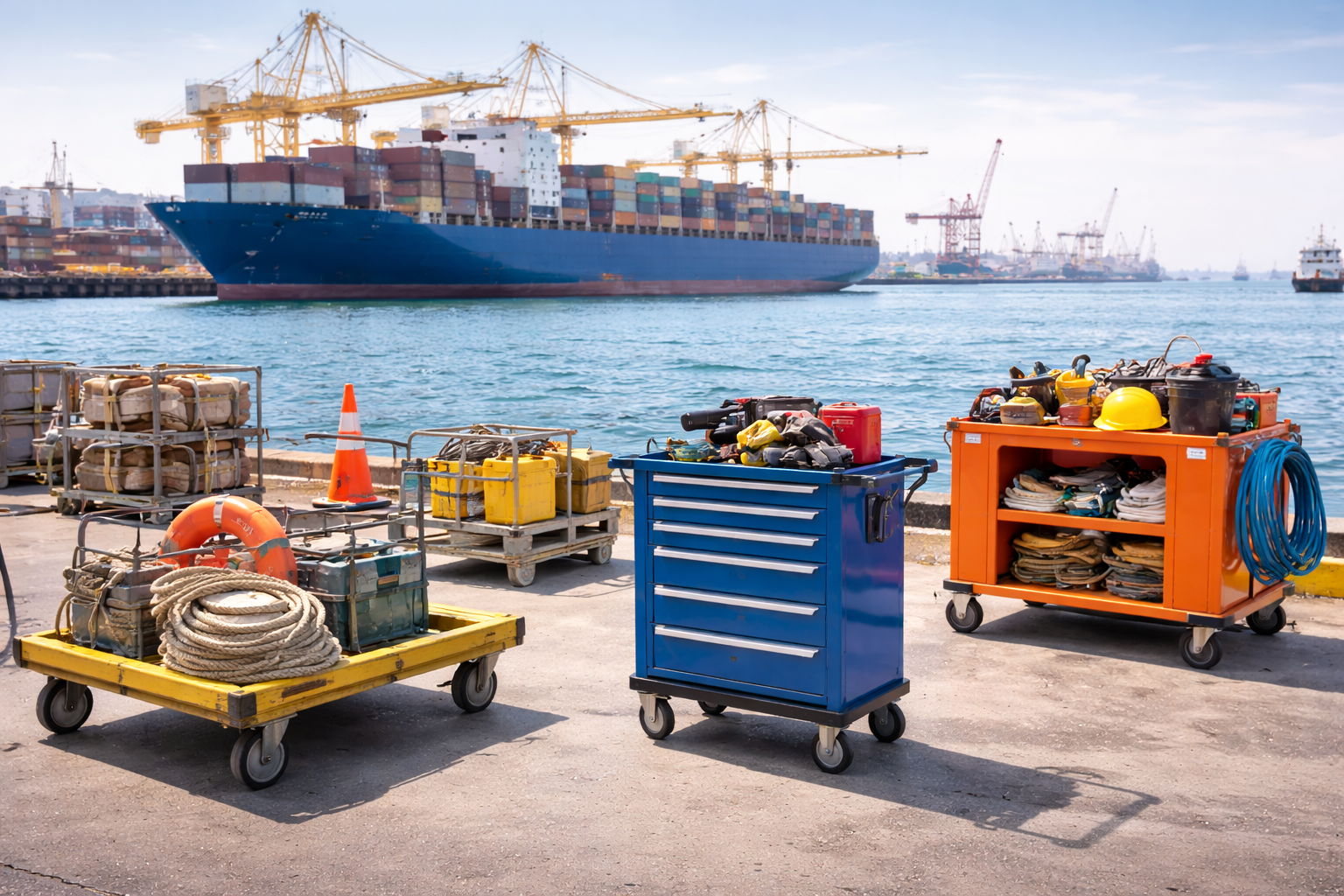
Marine-grade castors are essential across a wide range of applications. In ports and harbours, they support cargo trolleys, tool carts, maintenance rigs and safety equipment. In shipyards, they enable movement of welding equipment, fabrication tables and heavy tools near water.
On offshore platforms, they are used for utility carts, emergency response equipment and service trolleys operating in high humidity and salt exposure. In fisheries and seafood processing plants, hygienic stainless PU castors are required for wash-down environments.
Even in coastal power plants, desalination facilities and wastewater treatment plants near the sea, this combination ensures corrosion resistance, safety and long-term reliability.
Why Coated or Galvanized Castors Fail in Marine Conditions
Many operators attempt to save cost by using galvanized or epoxy-coated castors. While these coatings offer temporary protection, they inevitably fail under continuous salt exposure. Once the coating is scratched or eroded, corrosion spreads rapidly underneath, leading to hidden structural weakness.
PU wheels mounted on non-stainless brackets still fail because bearings seize and forks corrode. True marine durability requires material-level resistance, not surface-level protection. Stainless steel is therefore not a luxury—it is a necessity.
Lifecycle Cost: The Marine Reality Check
Marine operators often replace standard castors multiple times per year due to corrosion-related failure. Each replacement involves downtime, labour, safety risks and potential operational disruption.
Stainless steel & PU castors dramatically reduce replacement frequency, maintenance intervention and downtime. While initial procurement cost may be higher, the total lifecycle cost is significantly lower, especially in continuous-duty marine operations.
In many cases, the ROI is achieved within the first year of use.
How Rexello Engineers Marine-Grade Castor Solutions
Rexello designs castor systems specifically for salty, wet and humid environments. Its marine-grade offerings combine stainless steel brackets, sealed precision bearings, PU wheels with optimized hardness, and corrosion-resistant fasteners.
Rexello evaluates load behaviour, floor conditions, environmental exposure and duty cycles before recommending solutions. OEM support, CAD customization and batch consistency ensure that marine clients receive predictable performance across fleets and facilities.
Conclusion: Marine Mobility Demands Marine-Grade Engineering
In marine environments, failure is not a question of if, but when—unless components are engineered specifically for salt, moisture and humidity.
Stainless steel and PU castors outperform all alternatives because they address corrosion, load, hygiene, noise and lifecycle durability at a material and engineering level. They protect safety, reduce downtime and deliver predictable performance where standard wheels simply cannot survive.
For ports, shipyards, offshore facilities and coastal industries, marine-grade castors are infrastructure, not accessories.
CTA – Rexello
Operating in salty, wet or humid marine conditions?
Rexello supplies stainless steel & PU castors engineered for ports, harbours, shipyards and offshore facilities.
📧 info@rexello.com | 📞 +91-79001 47477 | 🌐 www.rexello.com